
Weekly Market News, 17 August 2026: Markets Now Price a 69% Chance of No Change at This Month's Fed Meeting

Currency moves rarely make the morning headlines, yet for globally mobile families they quietly shape pension income, property plans, school fees and everything that crosses a border. Each week we share the Market News from our partners at Agility Forex, the currency specialists we partner with for our currency exchange service, so you can see the macro picture that matters when your financial life spans more than one country.
In last week's edition the headline was a US economy that had shed jobs. This week the data did something quieter and, for anyone holding a cross-border balance sheet, arguably more consequential: nothing dramatic happened three times in a row. Inflation eased, retail spending fell for the first time in nine months, and the labour market kept softening. No single release was a shock. Together they moved the market's own view of the Federal Reserve further in a month than most single announcements manage, from a 47% chance of no change at this month's meeting to 69%. The Dollar fell, Sterling reached a level last seen on 12 May, and the euro reached one last seen in June. Here is what happened, and here is the week of 17 August 2026.
Key figures this week
Paratus note: the Provenance column states, for every row, where the figure came from and how it was published, because the difference between an exact value, an approach and a bound decides what a reader is entitled to conclude from it. All market figures are as published by Agility Forex in the commentary reproduced further down this page. Two rows are not: the symposium dates are the organiser's and are cited in full below, and the arithmetic row is marked as ours. Rows marked "Not published" record what the commentary does not state, which is as much a part of the week as what it does.
Measure | Value | Provenance | Detail |
|---|---|---|---|
US Consumer Price Index, year on year | 3.4% | Published exactly | Eased from 3.5% previously |
US Consumer Price Index, previous | 3.5% | Published exactly | The figure it eased from |
US Consumer Price Index, monthly | 0.1% | Published exactly | Described in the source as "just 0.1%" |
US retail sales, July | -0.6% | Published exactly | The first monthly decline in nine months |
US retail sales, months since the last decline | Nine | Published exactly | The length of the run that ended, not a date. The commentary gives no month for the previous decline |
US retail sales, June | +0.2% | Published exactly | Left unrevised |
Implied probability of no change at this month's Fed meeting | 69% | Published exactly | The market's own pricing, not a Fed statement |
The same probability, a month ago | 47% | Published exactly | The comparison the source itself draws |
The change between them | 22 percentage points | Paratus arithmetic on two exactly published values | Subtraction, not a separate published figure. The commentary does not describe the path between the two readings and neither do we |
Further rate rises priced by December | Less than one full rise | Published as a bound, not a quantity | A ceiling. No fraction, basis-point figure or probability is published anywhere below it |
GBP/USD | 1.3560 | Published exactly, as a level tested | A multi-month high |
GBP/USD, last seen at that level | 12 May | Published exactly | An exact date |
EUR/USD | 1.1585 | Published exactly, as a level tested | A multi-month high |
EUR/USD, further | Towards 1.1600 | Published as an approach, qualified "towards" | Not a print and not a close |
EUR/USD, last seen at 1.1600 | June | Published as a month, not a date | No day is published |
UK monthly GDP | +0.3% | Published exactly | Described as a surprise to the upside |
UK preliminary second-quarter GDP | +0.4% quarter on quarter | Published exactly | The basis for the G7 comparison below |
UK position in the G7 | "One of the stronger G7 growth performances" | Qualitative, unranked | No league position or ranking is published |
UK short-dated borrowing costs | "Among the highest in the developed world and well above eurozone levels" | Qualitative, no figure | No yield level and no spread in basis points is published |
Eurozone flash GDP | 0.4% | Published exactly | Read alongside the UK's preliminary 0.4% |
Eurozone industrial production | Flat | Described, no percentage published | Direction only |
UK Consumer Price Index, previous reading | 2.6% | Published exactly, as the previous print | Not this week's figure, and no expectation for this week's is published |
Jackson Hole | "At the end of the month" | Qualitative in the source | Exact dates added by Paratus from the organiser and cited below |
Employment report | "Softer" | Described, no number published | No payrolls figure, unemployment rate or earnings number appears |
GBP/EUR | No level published | Not published | Named as a cross to watch, with no rate attached |
Any central bank interest rate, in percent | Not published | Not published | No Fed, Bank of England or ECB rate level appears in this week's commentary |
How to read the figures on this page
Paratus framing (not Agility). General information, not financial advice.
Some of the numbers above are precise, some are qualified, and one is not a number at all but a ceiling. We separate them rather than blending them, because a week like this one turns on exactly that distinction:
Published exactly. Agility state the figure as a precise value. CPI at 3.4%, retail sales at -0.6%, and both probability readings of 47% and 69% are of this kind. Where a figure is exact we treat it as exact.
Published as an approach. EUR/USD "pushed towards 1.1600". Towards is not a print. The pair is separately reported as having *tested* 1.1585, which is a different and stronger claim. We keep the qualifier attached to the number every time it appears, rather than dropping it once the number has been introduced.
Published as a bound. Markets are pricing "less than one full hike by December". That is a ceiling with nothing underneath it: the commentary does not say whether the figure is a tenth of a rise or nine tenths, and it does not offer a probability. A bound is not a quantity, and we do not draw it as one. There is a section on this below, because a graphic circulated with this week's commentary does.
Not published. Several things are described by direction only, or named without a value: the employment report is "softer", industrial production is "flat", UK yields are "among the highest in the developed world". Where that is the case we say so rather than estimating. This week that includes every GBP/EUR level and every central bank interest rate.
This week at a glance
Three softer US readings, not one shock. Inflation eased to 3.4% year on year from 3.5%, with the monthly reading at just 0.1%. Retail sales fell 0.6% in July. The commentary sets both against the backdrop of a softer employment report and growing concern about the US labour market.
The first fall in retail sales in nine months. The July decline of 0.6% is described as another negative surprise, and the previous month's figure was left unrevised at 0.2%, so the fall is not the artefact of a revision to what came before it.
The market moved 22 percentage points on the Fed in a month. The implied probability of no change at this month's meeting is 69%, up from 47% a month ago. That is the market's own pricing shifting, and it happened without the Federal Reserve saying anything new.
Expectations for further rises were scaled back to a ceiling. Markets are now pricing less than one full rise by December. The commentary publishes no figure beneath that ceiling.
The Dollar took it broadly. By the end of the week both the euro and the pound had reached multi-month highs, with EUR/USD testing 1.1585 and GBP/USD 1.3560, the latter a level last seen on 12 May.
Sterling had its own support. UK monthly GDP surprised to the upside at 0.3% and preliminary second-quarter GDP came in at 0.4% quarter on quarter, which the commentary reads as leaving the UK on course for one of the stronger G7 growth performances in the first half of the year.
The euro rose without earning it. Eurozone flash GDP was 0.4% and industrial production was flat, yet EUR/USD pushed towards 1.1600, a level last seen in June. The commentary is explicit that this looks like Dollar weakness rather than a material improvement in the eurozone outlook.
Now the minutes decide. Wednesday brings six UK price readings in the morning and the record of the last Federal Reserve meeting in the evening, with the Jackson Hole symposium opening on 27 August.

The two figures the commentary publishes, and the distance between them. The coloured arc covers only the stretch from 47% to 69%; the path between the two readings is not drawn, because the commentary does not describe one. From the Paratus Wealth carousel for this week.
Market news, week commencing 17 August 2026
Agility verbatim begins. The commentary below is reproduced word for word from Agility Forex UK and must not be edited.
Paratus editorial note on the dating of this commentary. The heading immediately below is reproduced exactly as published, and it reads 10th August. The economic calendar contained in the same commentary covers Monday 17 to Friday 21 August 2026, and the market week reviewed is the week to Friday 14 August 2026. We have dated this page from the calendar, which is the internally consistent element, and we have left the masthead untouched rather than silently amending our partner's copy.
Market News - Monday 10th August 2026
The USD is still the main driver in the market and focus remains on interest rate expectations from the central banks.
The USD remained under pressure last week as a combination of softer inflation, weaker retail sales and growing concerns around the US labour market continued to push back expectations for further Fed rate hikes.
By the end of the week, the softer US data had pushed both EUR and GBP to multi-month highs, with EUR/USD testing 1.1585 and GBP/USD 1.3560 — the latter a level last seen on 12 May.
US, data continues to challenge the Fed
US CPI eased to 3.4% y/y, from 3.5% previously, with the monthly reading at just 0.1%.
Retail sales provided another negative surprise, falling 0.6% in July — the first monthly decline in nine months. The previous month's figure was left unrevised at 0.2%.
Against the backdrop of a softer employment report, the latest data is adding to concerns over the resilience of the US economy and putting further pressure on the USD.
Markets are now pricing a 69% probability of no change at this month's Fed meeting, up from 47% a month ago.
Expectations for further rate hikes have also been scaled back, with markets now pricing less than one full hike by December.
The next major focus: Jackson Hole at the end of the month, where markets will be looking for clearer guidance from the Fed on the path for rates.
GBP - Sterling continues to benefit
The UK data backdrop remains relatively supportive.
Monthly GDP surprised to the upside at 0.3%, while preliminary Q2 GDP came in at 0.4% q/q. This leaves the UK on course for one of the stronger G7 growth performances in the first half of the year.
Sterling is also continuing to benefit from favourable carry-trade dynamics, particularly against the euro.
UK short-dated borrowing costs remain among the highest in the developed world and well above eurozone levels, providing an ongoing yield advantage for sterling.
GBP/EUR remains an interesting cross to watch, with the combination of UK yields and a relatively softer eurozone backdrop continuing to favour the pound.
The euro, higher but largely on Dollar weakness
It was a relatively quiet week for eurozone data.
Flash GDP came in at 0.4%, while industrial production was flat.
EUR/USD nevertheless pushed towards 1.1600, a level last seen in June.
The key point is that the latest euro strength appears to have been driven more by broad-based USD weakness than a material improvement in the eurozone outlook.
The week ahead, in the source's words
UK
Tuesday: Average earnings, claimant count & unemployment
Wednesday: CPI — previous 2.6%
Friday: Retail sales; flash manufacturing & services PMI
Eurozone
Tuesday: ZEW
Wednesday: Final CPI
Thursday: Flash manufacturing & services PMI
US
Tuesday: Industrial production
Wednesday: FOMC meeting minutes
Thursday: Unemployment claims
Friday: Flash manufacturing & services PMI
Summary
The USD remains the key driver of FX markets. Softer US data is continuing to challenge expectations for further Fed tightening, while the UK data and yield backdrop remain relatively supportive for sterling.
This week's focus will shift towards UK inflation and labour-market data, alongside the FOMC minutes, with markets continuing to assess just how much scope the Fed has to keep rates higher for longer.
For now, USD downside remains the dominant theme, with EUR/USD and GBP/USD both testing important technical levels.
Written by Colette Archer (FX Dealer)
[Direct contact details omitted by Paratus Wealth.]
Agility verbatim ends. Everything that follows is Paratus Wealth's own commentary.
Less than one is not three
Paratus framing (not Agility). General information, not financial advice.
A summary graphic circulated with this week's commentary carries a panel headed "further rate hikes priced". It draws two solid ascending bars and a third, taller, dashed one. There is no axis, no label and no unit anywhere on it. Directly beside those bars sits the commentary's own sentence: markets are now pricing less than one full hike by December.
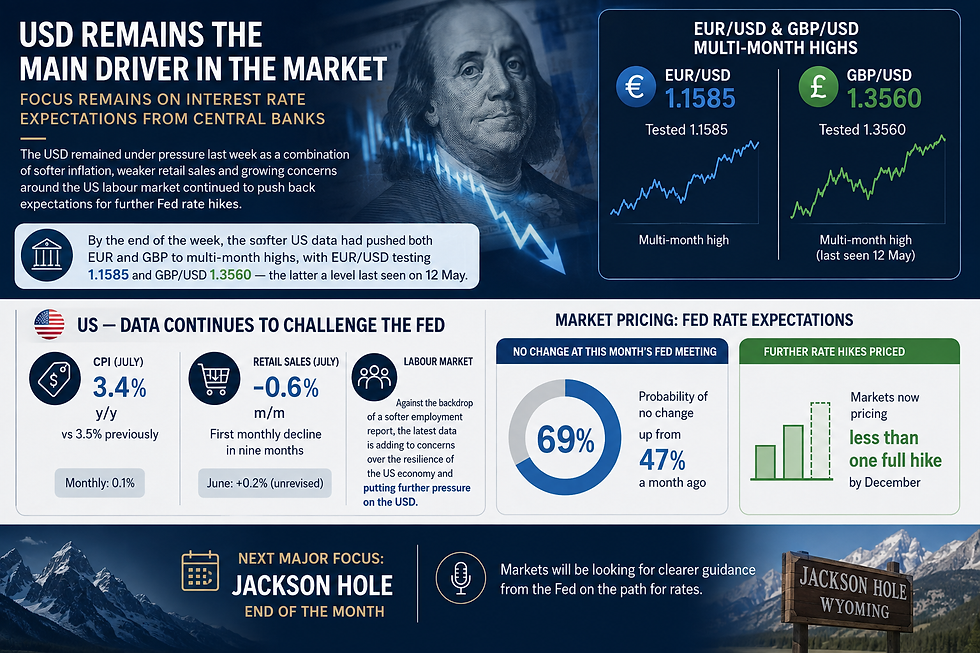
Reproduced from the summary graphic circulated with this week's Agility Forex commentary. The panel headed "further rate hikes priced" draws two solid ascending bars and a taller dashed third, beside the commentary's own sentence that markets are pricing less than one full hike by December. Those bars are not Paratus Wealth's reading of that sentence. The section below sets out why, and our own briefing draws the same figure as a bound rather than as a count.
Three ascending bars read as a count. A reader who glances at the panel and takes nothing else from the page comes away with an impression of two to three further rises. The sentence beside it says the total sits somewhere below one, and that expectations have been scaled back. The picture asserts roughly three times the quantity the words allow, and it does so while ascending, at the exact moment the words say the number fell.
Paratus does not adopt that reading, and our own briefing does not draw it that way.
A bound is not a quantity. "Less than one" tells you where the ceiling is and deliberately tells you nothing about where the value sits underneath it. Drawn honestly, that is an open, fading edge running up to a hard ceiling at one, with everything at and above the ceiling marked as not priced. It is not a bar with a top, because a bar with a top asserts a value the commentary never published.
This is not a pedantic distinction. "Less than one rise by December" and "two to three rises by December" imply opposite directions for the Dollar over the remainder of the year, and therefore opposite pressures on every cross a globally mobile family actually uses: the pension paid in one currency and spent in another, the mortgage in a second country, the school fees in a third. Reading the second where the source wrote the first is the kind of error that survives all the way into a decision.
What is published, exactly: that expectations for further rises have been scaled back, and that the total priced is less than one full rise by December.
What is not published, anywhere: any fraction, any basis-point figure, any probability for December, and any date on which any of it is expected to happen.
What a 69% probability actually is
Paratus framing (not Agility). General information, not financial advice.
The single most quoted number this week is a market-implied probability, and it is worth being precise about what one is, because it is easy to read as something firmer than it is.
A market-implied probability is read out of the prices of interest rate contracts. It tells you what traders are collectively betting, and it moves every time they change their minds. It is not a Federal Reserve statement, it is not a forecast anyone is accountable for, and it is not a schedule. It is a thermometer for sentiment, taken at a moment.
Two things follow. First, 69% is the odds the market is placing, not the odds of being right; the same measure was 47% four weeks earlier and nothing about the Federal Reserve's stated position changed in between. Second, a 22 percentage point move in a month is large by the standards of this measure, and the fact that it happened on the accumulation of three unremarkable data releases rather than on any announcement is the actual story of the week.
Jackson Hole: the dates, and why the calendar matters
Paratus framing (not Agility). The dates below are the organiser's, cited. General information, not financial advice.
Agility name Jackson Hole as "the next major focus" and give no date. Because that is the single forward-looking event the commentary points at, we have added the schedule from the body that publishes it.
The Federal Reserve Bank of Kansas City states that the 2026 Jackson Hole Economic Policy Symposium takes place on 27 to 29 August 2026, in Jackson Hole, Wyoming, and that this year's topic is "Financial Innovation: Implications for Payments and Policy".
Source: Federal Reserve Bank of Kansas City, *Jackson Hole Economic Symposium*, kansascityfed.org/research/jackson-hole-economic-symposium, retrieved 19 August 2026. The page states: "The 2026 Jackson Hole Economic Policy Symposium will take place Aug. 27-29. The topic is 'Financial Innovation: Implications for Payments and Policy.'"
That is a schedule and nothing more. No expectation of any outcome is published in this week's commentary and none is offered here. Markets read the symposium for guidance on the path for rates, which is the same thing that has been repricing all month, and that is the whole of why the date is worth knowing in advance.
Key economic data this week

The calendar below is reproduced from the economic calendar published with this week's commentary. The counts are of the entries on that calendar. No expected value or previous reading is published for any entry except UK CPI, whose previous print of 2.6% is given in the commentary.
Monday 17th August
Quiet start · 4 releases
UK Rightmove HPI m/m
US Empire State Manufacturing Index
US NAHB Housing Market Index
US TIC Long-Term Purchases
Tuesday 18th August
UK labour market · 14 releases
EU ZEW Economic Sentiment
EU German ZEW Economic Sentiment
UK Claimant Count Change
UK Average Earnings Index 3m/y
UK Unemployment Rate
UK 10-y Bond Auction
US ADP Weekly Employment Change
US Building Permits
US Housing Starts
US Import Prices m/m
US Capacity Utilization Rate
US Industrial Production m/m
US Pending Home Sales m/m
US API Weekly Statistical Bulletin
Wednesday 19th August
UK inflation and the Fed minutes · 13 releases
EU ECB President Lagarde Speaks
EU Current Account
EU Final Core CPI y/y
EU Final CPI y/y
EU German 10-y Bond Auction
UK CPI y/y
UK Core CPI y/y
UK PPI Input m/m
UK PPI Output m/m
UK RPI y/y
UK HPI y/y
US Crude Oil Inventories
US FOMC Meeting Minutes
Thursday 20th August
Claims and surveys · 7 releases
EU German PPI m/m
EU German Buba Monthly Report
UK CBI Industrial Order Expectations
US Philly Fed Manufacturing Index
US Unemployment Claims
US CB Leading Index m/m
US Natural Gas Storage
Friday 21st August
Flash PMI day, all three blocs · 14 releases
EU French Flash Manufacturing PMI
EU French Flash Services PMI
EU German Flash Manufacturing PMI
EU German Flash Services PMI
EU Flash Manufacturing PMI
EU Flash Services PMI
EU Consumer Confidence
UK GfK Consumer Confidence
UK Retail Sales m/m
UK Public Sector Net Borrowing
UK Flash Manufacturing PMI
UK Flash Services PMI
US Flash Manufacturing PMI
US Flash Services PMI
Total: 52 scheduled entries.
The shape of this week is unusual, and it is worth seeing before it happens. The UK supplies most of the hard data, on Tuesday and Wednesday. The US supplies the interpretation, in the Federal Open Market Committee minutes on Wednesday evening. Then on Friday all three blocs report the same survey on the same morning: ten flash purchasing managers' readings in total, six from the eurozone counting France, Germany and the bloc aggregate, two from the UK and two from the US. Anyone watching a single currency pair will find that its two halves are being repriced by different calendars.
What the FOMC minutes are, and what they are not
Paratus framing (not Agility). General information, not financial advice.
Wednesday evening's release is the record of a meeting that has already happened. The minutes set out the reasoning behind a decision already taken, in more detail than the statement issued on the day.
They are not a statement of intent about the next meeting, and they are not a forecast. Markets read them for tone: for how much scope the Federal Reserve believes it has to keep rates higher for longer, which is the phrase the commentary itself uses. That is why a backward-looking document can still move a currency pair, and why a Wednesday that already carries six UK price readings in the morning carries a second, separate repricing in the evening.
For anyone with an exposure that spans the Atlantic, the practical point is the timing rather than the content. The sterling side of GBP/USD is repriced in the morning, on UK inflation. The Dollar side is repriced in the evening, on an American document. Both land on one calendar day.
What a week like this means for globally mobile families
Paratus framing (not Agility). General information, not financial advice.
A multi-month high is good news or bad news depending entirely on which way your money is moving. For people whose financial life crosses a border, that is not an abstraction, and the three positions below are genuinely different.
If you hold sterling and spend Dollars. GBP/USD reached a level last seen on 12 May. For anyone whose school fees, property costs or day-to-day living costs are in Dollars while their income is in sterling, the published level sat higher in the week to 14 August than at any point in the previous three months. That is a statement about where a level sat during the week the commentary reports. It is not the rate available on any given day, and the commentary offers no view on how long the move lasts.
If you are paid in Dollars and live elsewhere. The same move works against you. A Dollar income converted into sterling or euros buys less this week than it did in the spring. The commentary describes pressure on the Dollar as the dominant theme *for now*, which is a description of a prevailing condition rather than a completed move.
If your pension is paid in one currency and spent in another. This is the position most expatriate retirees are actually in, and it is the one where a currency move compounds rather than passing through once. A retirement income does not get to wait for a better rate. What can be planned is the timing and the structure of conversions, and how much of a liability is matched to the currency it is denominated in. The rate itself cannot be planned by anyone.
If you hold euros. The euro is higher, and on the commentary's own reading it is higher because the Dollar is lower rather than because the eurozone economy improved. Flash GDP of 0.4% and flat industrial production is the whole of the eurozone's published week. Strength that arrives from the other side of a currency pair behaves differently from strength that arrives from home, and it can unwind for reasons that have nothing to do with Europe.
Nothing in this section is a recommendation to convert, to hold or to delay. It is a description of who is affected by the week the source reports, so that the right question gets asked at the right time. The decision belongs with your own adviser and your own circumstances.
How Paratus Wealth can help
Paratus framing (not Agility). General information, not financial advice.
Currency is one part of a cross-border plan, and it is rarely the part that is planned first. Paratus Wealth works with globally mobile families across the whole of it:
Currency and cost-of-living planning, including our currency exchange service with Agility Forex, for people who move money between currencies regularly rather than once.
Protection and life cover and life insurance that remains valid when you move country.
Savings and investments structured for someone who may not retire in the country they are working in.
Retirement planning and cashflow modelling, which is where a currency exposure stops being a market question and becomes an income question.
Pension review, SIPPs and QROPS for pensions left behind in one country and drawn in another.
UK Inheritance Tax planning for people whose estate is exposed to a system they no longer live under.
If any of this week's movement touches a decision you were already weighing, contact our team and we will talk it through.
Related reading
Attribution and disclaimer:
Market News written by Colette Archer (FX Dealer), Agility Forex. Shared by Paratus Wealth with permission. The commentary above is general market information provided by Agility Forex and is reproduced verbatim. It is for information only, does not constitute financial, investment or currency advice, and should not be relied upon as such. Figures are as published by Agility Forex UK and cover the market week to Friday 14 August 2026; levels quoted are levels tested or approached during that week, not closing prices, and market levels change continuously. Where a figure is qualified in the source, the qualifier is retained here. Outcomes described for forthcoming releases are conditional scenarios set out in the source, not forecasts, and no forecast of any rate, level or price is offered on this page. The Jackson Hole symposium dates are published by the Federal Reserve Bank of Kansas City and are stated as a schedule only. Paratus Wealth does not provide services to, and does not market to, residents of the United Kingdom. Any UK references in this commentary relate to cross-border exposure for people living outside the UK. Currency and investment values can fall as well as rise. This page is also subject to the full Paratus Wealth regulatory disclaimer shown in the site footer. To talk through your own circumstances, contact our team.



Comments