
SIPP vs QROPS: the 2026 guide for expats transferring a UK pension

Updated: Sep 10
Last reviewed: 3 July 2026, by a Senior Partner & Financial Adviser, Paratus Wealth. Figures checked against the GOV.UK and HMRC sources listed at the end of this guide.
If you have built up a UK pension and now live abroad, you have almost certainly been told two things: that you should “do something” with it, and that a QROPS is the answer. Both may be true. Neither is automatically true. And a rule change on 30 October 2024 has quietly turned what used to be a straightforward decision into one where the wrong move can cost you a 25% tax charge on the whole transfer.
This guide explains, in plain English, how an International SIPP and a QROPS actually differ in 2026, when the new Overseas Transfer Charge bites, how the 2027 inheritance-tax change affects both, and how to work out which route fits your life and your long-term plans. It is general information, not advice, but it is the same framework a Paratus Wealth Senior Partner would walk you through.
The short answer: an International SIPP keeps your UK pension inside the UK system; a QROPS moves it to an HMRC-recognised overseas scheme. Since 30 October 2024, transferring to an EEA or Gibraltar QROPS can trigger a 25% Overseas Transfer Charge unless an exclusion applies, most commonly that you live in the same country as the scheme. That one change now decides the International SIPP vs QROPS question for many expats.
Key takeaways
A SIPP keeps your pension inside the UK system; a QROPS moves it into a qualifying overseas scheme. Both can be managed from abroad.
Since 30 October 2024, transferring to a QROPS based in the EEA or Gibraltar no longer gives an automatic exemption, so many such transfers now trigger the 25% Overseas Transfer Charge.
From 6 April 2027, most unused pension funds fall within UK inheritance tax, which matters for both routes.
The right choice depends on where you live, whether you might return to the UK, your fund size, currency needs and your nationality. US persons need specialist care.
A QROPS has its own costs and conditions to weigh, including charges and the five-year rule, so it is worth comparing carefully.
This is general information, not a personal recommendation. Speak with a regulated adviser before transferring.
Why this choice matters more than it used to
For a globally mobile family, a UK pension is often the single largest asset that stays behind when you leave. Managing it from abroad raises real, practical questions: can you still contribute, how is it taxed where you live now, what currency will you draw it in, and what happens to it if you pass away while resident overseas? The “SIPP or QROPS” decision sits underneath all of these.
It matters more in 2026 because the goalposts have moved. The abolition of the Lifetime Allowance in 2024, the removal of the EEA and Gibraltar exemption from the Overseas Transfer Charge, and the arrival of pensions inside inheritance tax from 2027 mean that guidance written even eighteen months ago can now send you in the wrong direction. Getting current, cited information is the whole game, and it is where most articles you will find are quietly out of date. If you would rather work through this as a checklist, we have made one: ten questions to ask before you move a UK pension abroad. 19 pages, free.
[ Get the checklist ] → Expat Pension Transfer Checklist
What is an International SIPP?
A Self-Invested Personal Pension (SIPP) is a UK-registered pension scheme. An “International” SIPP is simply a SIPP designed with expatriates in mind, typically offering multi-currency accounts and a wider investment range, but the pension itself stays firmly within the UK tax and regulatory system. Contributions attract UK tax relief up to your annual allowance, and you can normally access benefits from age 55, rising to 57 from 6 April 2028.
When you take money out, the usual position is 25% tax-free with the balance taxed as income, via flexible drawdown or lump sums (UFPLS). Because it remains a UK scheme, an International SIPP is generally the more familiar, more heavily regulated and more transparent of the two options, and it keeps the door open if you ever return to the UK. Learn more about the International SIPP and a pension review.
What is a QROPS?
A Qualifying Recognised Overseas Pension Scheme (QROPS) is a non-UK pension scheme that has told HMRC it meets certain conditions, allowing UK pension benefits to be transferred to it. HMRC publishes a ROPS notification list, updated on the 1st and 15th of each month, but crucially HMRC does not guarantee that a listed scheme really qualifies or that a transfer will be tax-free. That responsibility sits with you.
A QROPS can offer genuine advantages for the right person: consolidation into your country of residence, drawing benefits in local currency, and potential local tax and estate-planning efficiencies. But HMRC’s reporting reach continues for five full UK tax years after you become non-resident, and, as we will see, the transfer itself can now attract a 25% charge. Explore our QROPS transfer planning.
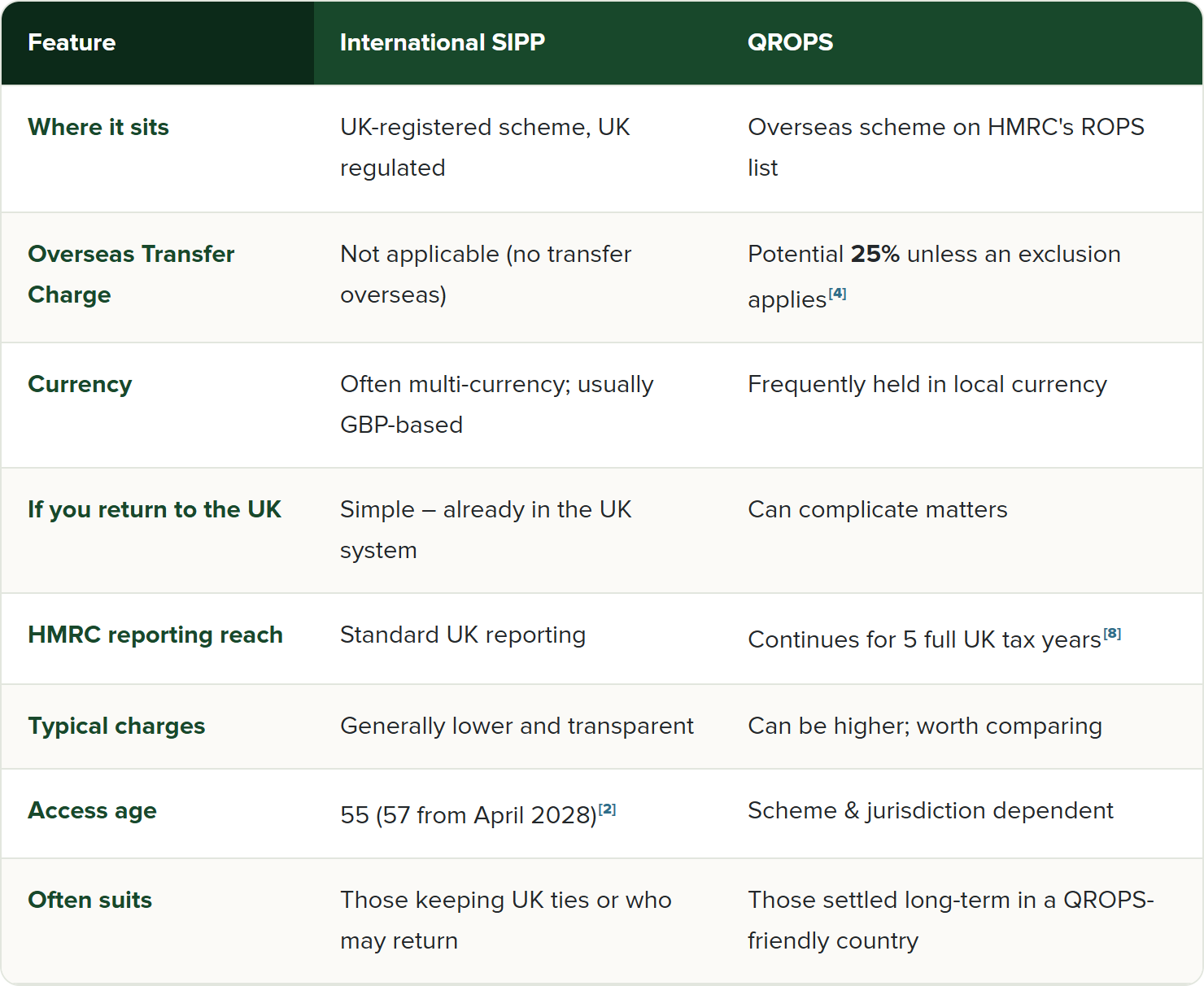
SIPP vs QROPS at a glance
The table below is a starting orientation, not a recommendation. Every line has exceptions that depend on your country of residence and the specific scheme.
The 25% Overseas Transfer Charge — the 2024 change that changes everything
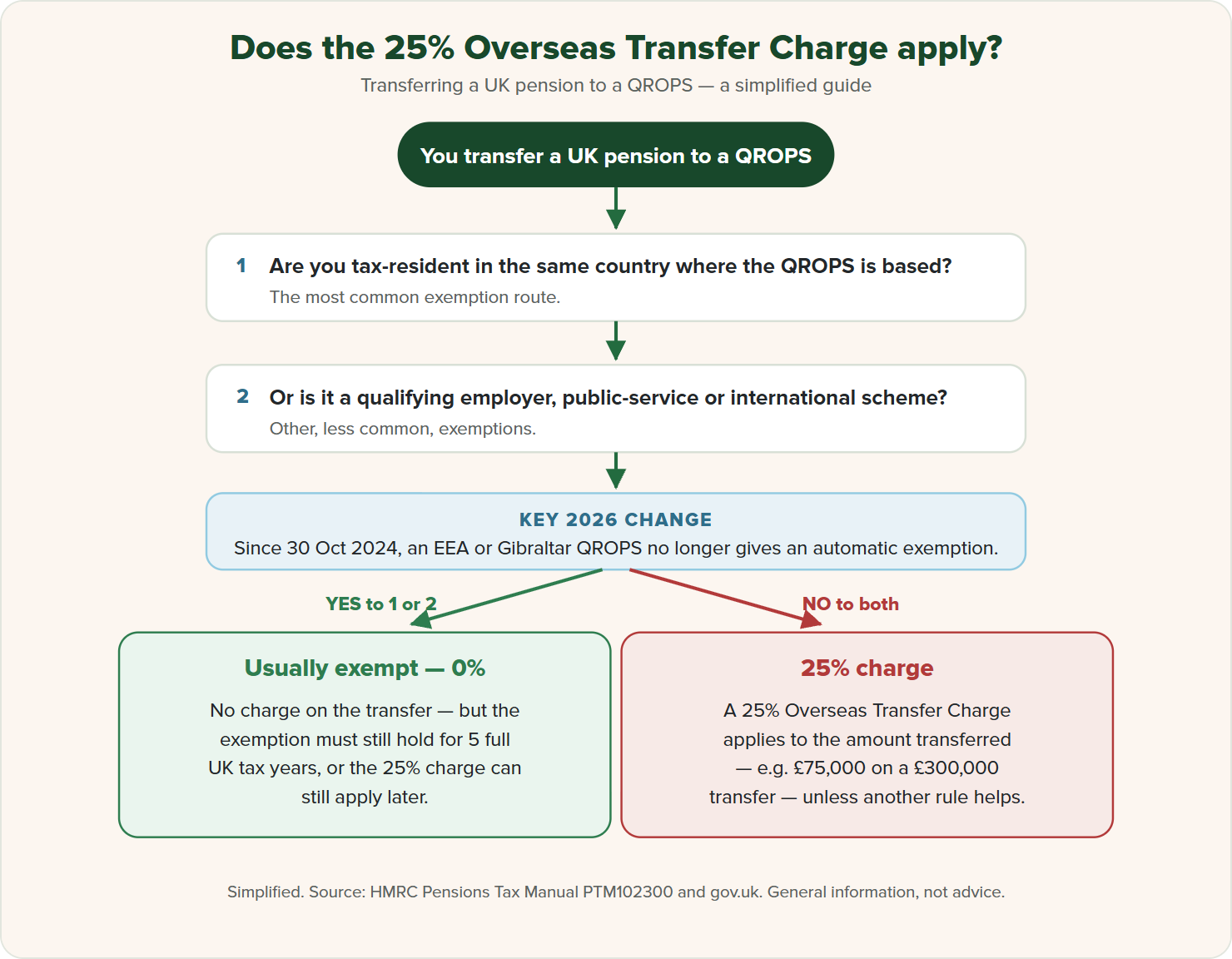
This is the single most important, and most misunderstood, part of the decision in 2026. The Overseas Transfer Charge (OTC) is a 25% tax on the amount you transfer from a UK pension to a QROPS. It does not apply to every transfer, but the list of exemptions shrank sharply in the Autumn 2024 Budget.
Historically, transfers to a QROPS based in the European Economic Area (EEA) or Gibraltar were excluded from the charge. With effect from 30 October 2024, that exclusion was removed. Transfers to an EEA or Gibraltar QROPS now attract the 25% charge unless another exemption applies, such as the member being tax-resident in the same country as the QROPS. (A transfer requested before 30 October 2024 could still use the old exemption if completed before 30 April 2025.)
Why this matters. A lot of guidance still online was written when a Malta or Gibraltar QROPS was a default “no-charge” home for a UK pension. For many people that is no longer the case, so it is well worth confirming your position before you move. On a £300,000 pension, the difference can be as much as £75,000.
Not sure whether the 25% charge would apply to you? That is a short, no-obligation conversation with a Senior Partner, mapped to your country of residence. Book a discovery call.
Tax when you live abroad
With a SIPP, UK payments are technically subject to UK PAYE, but a Double Taxation Agreement between the UK and your country of residence can remove the UK tax, actioned by HMRC issuing an “NT” (No Tax) code once your claim is certified abroad. You then pay tax where you live, if at all. With a QROPS, the pension usually falls under the tax rules of the scheme’s jurisdiction and your residence, which can be efficient, or can create new reporting duties. Neither is universally “lower tax”, it depends entirely on your country, which is why this is a planning question rather than a product question. Currency matters too: our currency exchange service is built for exactly the cross-border income transfers pensions create.
Pensions and inheritance tax from 2027
Historically, unused pension funds usually sat outside your estate for inheritance tax. That is changing: from 6 April 2027, most unused pension funds and death benefits will be brought within the estate for UK IHT, with personal representatives responsible for reporting and paying. This affects SIPPs and can affect QROPS depending on your long-term UK residence position, and it makes estate planning inseparable from the SIPP-versus-QROPS decision. We cover this in depth in our companion guides on IHT on pensions in 2027 and UK inheritance tax planning.
Two carve-outs matter. Death benefits passing to a surviving spouse or civil partner are expected to remain exempt under existing inheritance tax principles, and death-in-service benefits from registered schemes are excluded from the change. Note that the new treatment applies to deaths on or after 6 April 2027 whatever your age at death, which changes the picture for anyone relying on the old treatment of funds passed on before age 75.
Key considerations when weighing an International SIPP
For many expatriates the International SIPP is the natural home for a UK pension, precisely because it keeps things simple, transparent and inside a system you already understand. These are the points to weigh, and each is an area where Paratus works with clients day to day.
Keeping your options open. Because the pension stays in the UK system, a SIPP is the more flexible choice if there is any chance you will return to the UK, or you are simply not ready to commit to one country for good. The 25% Overseas Transfer Charge never applies to a SIPP.
Bringing scattered pensions together. Consolidating several old UK workplace and personal pensions into a single International SIPP can lower cost, simplify administration and give you one clear view, one of the most common pieces of work we do for new clients.
Investment choice and currency. An International SIPP typically offers a wide investment range and multi-currency facilities, so your portfolio can be shaped around where you actually live and the currency you will spend in.
Clear, competitive charges. SIPPs are generally lower-cost and more transparent than overseas alternatives. We set costs out in full, so you can see exactly what you are paying for and why.
Tax-efficient income abroad. With the right Double Taxation Agreement and an HMRC “NT” code, SIPP income can often be paid free of UK tax and taxed only where you live. Getting that paperwork right is a specialism we handle for clients.
Ongoing management, not a one-off decision. An International SIPP works best when a Senior Partner reviews it with you over the years, which is exactly how Paratus is set up to look after it.
Key considerations when weighing a QROPS
A QROPS can be an excellent home for a pension in the right circumstances. Whether it is right for you comes down to a handful of practical questions, and this is exactly where good planning earns its keep.
Whether the 25% charge applies to you. The single biggest factor in 2026 is where you live and where the scheme is based. For most expats in the EEA or Gibraltar the old exemption no longer applies, so this is the first thing to check.
Your five-year horizon. An exempt transfer can still change status if your circumstances change within five full UK tax years, so your plans over the next few years matter as much as today’s position.
Where you are now, and where you might go next. A QROPS tends to suit expats who are settled overseas for the long term. If a return to the UK is possible, keeping a UK SIPP often preserves more flexibility.
Where your adviser is based and regulated. Cross-border pensions are a specialist area, so it is worth confirming your adviser holds the right permissions for your country of residence. You can check any UK-regulated firm on the FCA register.
Charges and structure. Ask for a full, itemised breakdown of costs so you can compare options like for like, this is standard good practice and something we set out clearly for every client.
Currency and reporting. A QROPS can pay income in a different currency and introduce new local reporting duties, both worth planning for in advance.
If you are a US person. US citizens and green-card holders face additional complications, including PFIC rules and US–UK tax-treaty interactions, that this guide does not cover. Please speak with the Paratus Wealth US team before considering any pension transfer.
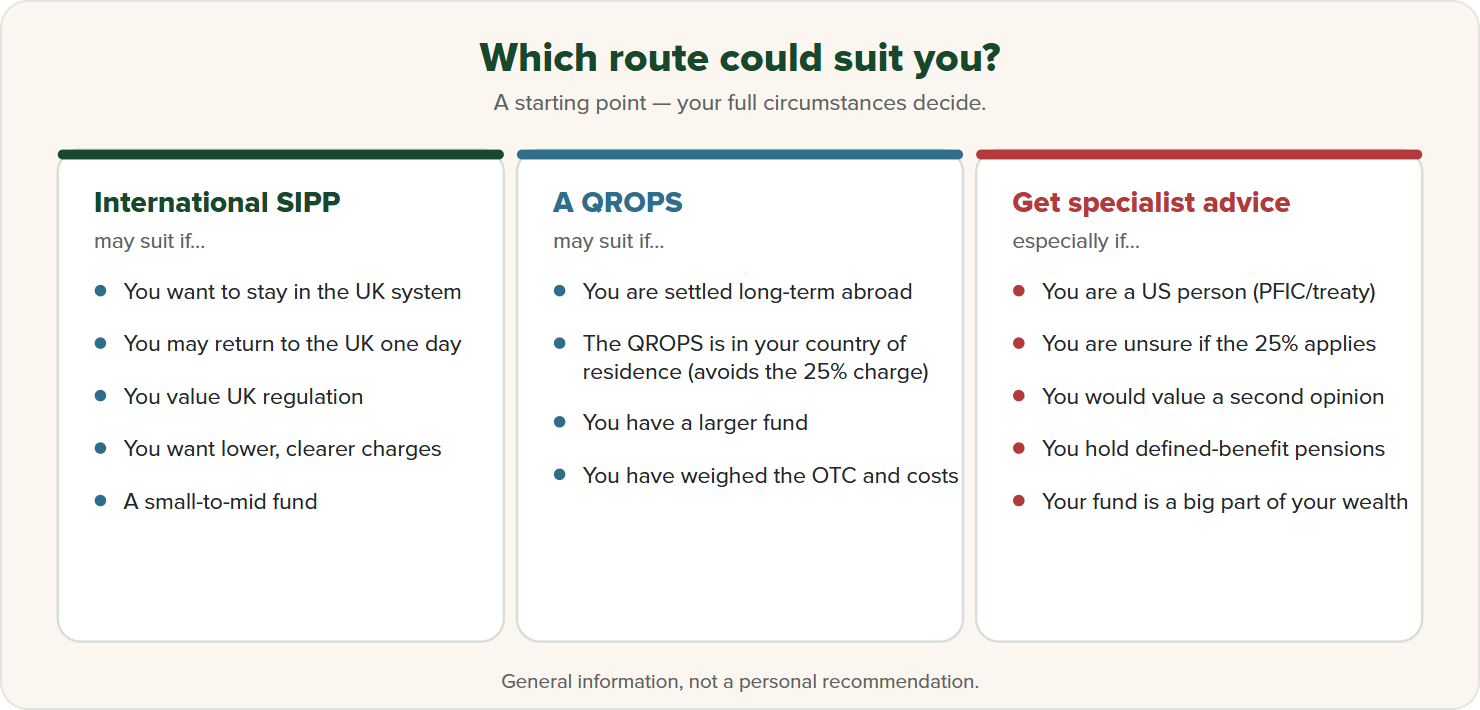
Which could suit you? Three real-world pictures

James, 58 · settled in Dubai · £600,000 pension. James has no plans to return to the UK and is tax-resident in the UAE. Because the UAE has no personal income tax, and a QROPS is not based there, his decision hinges on charges, investment quality and the OTC position rather than a currency or local-tax advantage. For many in his position, a well-run International SIPP with an NT code is simpler and cheaper than a QROPS, but it is genuinely a case-by-case call.
Illustrative arithmetic makes the point: if James moved his £600,000 to a Malta QROPS while living in the UAE, the transfer would sit outside the same-country exclusion and could attract a £150,000 charge. Held in an International SIPP instead, that charge never arises. This is an illustration only, not a projection or a recommendation.

Sophie, 45 · living in Spain · may return to the UK. Sophie is early in her overseas life and unsure whether she will stay. Transferring to a Spanish-facing QROPS could now trigger the 25% charge, and would complicate a future UK return. Keeping her pension in a UK SIPP preserves flexibility while she decides.

David · a US green-card holder in France. David’s situation is dominated by US tax rules, not UK ones. A standard QROPS or SIPP analysis needs to account for that first, which is why he should speak with the Paratus US team at the outset.
Other options worth weighing
The choice is rarely binary. Before transferring anywhere, it is worth considering whether to leave the pension where it is (often the right answer for smaller or workplace pensions), consolidate several UK pensions into one International SIPP for simplicity and lower cost, or simply commission a full pension review before making any move. A whole-of-market review looks at your entire picture, including investments, protection and cashflow modelling, so the pension decision fits the whole plan rather than being made in isolation.
If you have a defined-benefit (final salary) pension. Transferring a defined-benefit scheme is a high-stakes and often irreversible decision that calls for specialist advice, and in many cases staying in the scheme is the better outcome. Treat it as a separate, carefully-advised question from the SIPP-versus-QROPS choice above.
What about a QNUPS?
You may also hear about a QNUPS, a Qualifying Non-UK Pension Scheme. It is a different vehicle again: an overseas pension that has never held UK tax-relieved transfer funds, sometimes used for additional retirement saving above UK allowances. It is not a standard destination for transferring a UK pension in the way a QROPS is, and it brings its own costs and complexity. If a QNUPS has been suggested to you, treat it as a separate conversation with a specialist.
What a pension transfer actually involves
Whichever route fits, the mechanics follow a similar path, and knowing the shape of the process removes a lot of the anxiety. Timescales vary by provider and complexity, but a well-run transfer typically looks like this.
Discovery and authority. You sign a letter of authority so your existing schemes can disclose transfer values, charges and any guarantees. Providers typically take two to four weeks to respond.
Analysis. The Overseas Transfer Charge position, the relevant double taxation agreement and any safeguarded benefits are checked. If you hold defined benefit or other safeguarded rights worth more than £30,000, UK rules require regulated transfer advice before a scheme will allow the transfer.
Selection and disclosure. The receiving scheme is chosen and every cost is set out in writing before you commit to anything.
Execution. Transfer forms, identity checks and the schemes’ own due diligence. A straightforward defined-contribution transfer commonly completes in four to twelve weeks; a QROPS transfer can take longer because of the additional HMRC reporting involved.
After the transfer. Where relevant, the NT code application so income can be paid without UK tax deducted, then investment implementation and a review date in the diary. A transfer is the start of the plan, not the end of it.
How Paratus Wealth can help
This is exactly the kind of cross-border decision Paratus Wealth is built to handle. We look after UK pensions for globally mobile families every day, so instead of weighing SIPP against QROPS on your own, a Senior Partner will map your existing pensions, model the tax and Overseas Transfer Charge position for your specific country of residence, and set your options out clearly and in full, so you can decide with confidence rather than under pressure.
Whichever route fits, we are set up to run it end to end: International SIPP consolidation and administration, currency-aware income through our own exchange service, and joined-up estate, investment and protection planning under one roof, reviewed with you year after year. The first conversation is simply a discovery call, with no obligation.
Free download: The Expat Pension Transfer Checklist — the ten questions to ask before you move a UK pension abroad, including the 2024 Overseas Transfer Charge check.
Frequently asked questions
Is a QROPS worth it, or is a SIPP better for expats?
No. A QROPS suits people who are settled long-term in a country with a suitable scheme and who have weighed the costs and the Overseas Transfer Charge. For many expats, especially those who may return to the UK or whose QROPS would be in a different country to where they live, a UK International SIPP is simpler and cheaper. It is a personal decision, not a default.
What is the 25% Overseas Transfer Charge and when does it apply?
It is a 25% tax on the value you transfer from a UK pension to a QROPS. It applies unless an exclusion is met, most commonly that you are tax-resident in the same country as the QROPS. Since 30 October 2024, transfers to a QROPS in the EEA or Gibraltar no longer receive an automatic exclusion, so many now attract the charge.
Do I pay tax if I transfer my UK pension abroad?
Transferring does not automatically reduce tax, and can now cost 25% up front. Whether your pension is taxed in the UK or your country of residence usually depends on a Double Taxation Agreement, which can apply to a UK SIPP too. This is a planning question best answered with advice.
Will my pension be subject to UK inheritance tax?
From 6 April 2027, most unused pension funds are expected to fall within the estate for UK inheritance tax, with your personal representatives responsible for it. This applies to SIPPs and may apply to QROPS depending on your circumstances, so it should be built into the decision.
At what age can I access my pension?
The Normal Minimum Pension Age is currently 55, rising to 57 from 6 April 2028. Access before that age is not normally possible, and offers of earlier access fall outside the pension rules and are a recognised warning sign; you can check any firm on the FCA register.
How do I check a QROPS is genuine?
HMRC publishes a ROPS notification list, but being on it does not guarantee a scheme qualifies or that a transfer is tax-free. Always take regulated advice and check the adviser on the FCA register before transferring.
I am a US citizen living abroad. Does this guide apply to me?
Not fully. US persons face PFIC and US–UK treaty issues that change the analysis entirely. Please speak with the Paratus Wealth US team before doing anything.
What does a pension review with Paratus involve?
A Senior Partner reviews your existing UK pensions, models the tax and Overseas Transfer Charge position for where you live, and sets out your realistic options, with no obligation to proceed. Book a discovery call to start.
Sources & further reading
GOV.UK — Increasing the Normal Minimum Pension Age (55 to 57 from April 2028)
GOV.UK — Reducing tax-free overseas transfers (EEA/Gibraltar exemption removed from 30 October 2024)
GOV.UK — Inheritance Tax on unused pension funds and death benefits (from 6 April 2027)
GOV.UK — Abolition of the Lifetime Allowance from 6 April 2024
GOV.UK: HMRC Pension schemes newsletter 164, October 2024 (transitional rules for transfers requested before 30 October 2024 and completed before 30 April 2025)
Important. This article is general information for people living outside the United Kingdom and is not personal financial, tax or pension advice, nor a recommendation to transfer any pension. Pension and tax rules are complex, depend on your individual circumstances and country of residence, and can change; figures are correct as at July 2026. Transferring a defined-benefit pension, or any pension, may not be in your interests. Paratus Wealth does not provide services to, and does not market to, residents of the United Kingdom. US persons should seek advice from the Paratus Wealth US team. Always obtain regulated advice and verify any firm on the FCA register before acting. This page is subject to the full Paratus Wealth regulatory disclaimer shown in the site footer.


Comments